Friday, 20 September 2013

Tom and Jerry: A friendship fueled by parasites?

Parasites have been shown to permanently remove the innate fear that mice have towards cats, which could give us key information in the treatment against schizophrenia. 

For as long as there have been mice, there have been cats to chase those mice around. Neither of them can help it, it's in the cats nature to chase, and the mouses to be chased. It's built into the mouses brain at a cellular level to fear cats, and run from any sign of them. This is a very important reaction for a mouse to have, as any other reaction would probably result in their untimely demise. 

However, recent research has suggested that the parasite Toxoplasma, which is a very common infection in humans, may be able to alter the brains of mice and eradicate their innate fear. Not only this, but it has also been shown that the effect of Toxoplasma is retained in the mouse long after the infection has cleared, suggesting that this change in the mouses behaviour is permanent and causes structural changes within the brain. 

An infection by Toxoplasma induces a disease called Toxoplasmosis. Whilst most mammals and birds can be infected by this disease, the fear eradicating side effect seen in mice is totally unique. 

Now, one of the biggest questions is obvious, why? Why would a parasite want to make its host less scared of cats? This actually happens so that the parasite can compete its life cycle. The only place that Toxoplasma can sexually reproduce is inside the cats intestines, and the only way it can get there is for the mouse that it's living in to be eaten. 

This could help put the cartoon Tom and Jerry into a brand new perspective. Whilst we all thought we were watching a cat and a mouse running around in a bitter rivalry, what we were actually witnessing was just one stage in a parasites life cycle who had evolved over millions of years to fill in that one particular niche. Who'd have thought it ay? 


It's all good and well having this very interesting piece of information, but in what ways, if any, can it relate to us as humans to help us understand ourselves?

Well, it turns out that this parasite is also prevalent in a large number of patients with schizophrenia, one of the symptoms of which is an increase in the levels of neurotransmitter dopamine. It is thought that the parasite can induce this increase by forming microscopic cysts that grow inside a number of brain cells, which increases their production of dopamine. In actual fact, the treatment against schizophrenia usually involves treatment against this infection. 

However, because this loss of fear in mice is persistant and retained long after the infection has cleared, the changed induced by Toxoplasma must occur before cysts are formed, and must adapt the brain at a very basic level. This calls into question the theory of cysts increasing dopamine release being the cause of this behavioural change, potentially nullifying treatment against schizophernia that target cysts. 

As with most research, this has raised more questions that it has answered. However, it has given us more crucial information on schizophrenia, and allows us to take one more step toward the effective treatment of this disease. 

What do you think about this piece of research? Write below with your comments and questions and don't forget to +1 and share if you enjoyed this article. 

If you're particularly interested in this research then you can find the original paper here.

Wednesday, 18 September 2013

Mystery solved as to why flies are so hard to catch.

Research produced by both Trinity College Dublin and the University of Edingburgh has shown that the way animals perceive the passage of time around them is linked to how active that animal is within its environment.  

In the past research has shown that the characteristics of an organism is limited by the size of its body and its metabolic rate. However, this more recent piece of research has also shown that an organisms ability to perceive its environment is equally important in limiting how well it can exploit its environment. 

For example, a species which is capable of quickly identifying a threat will be able to survive for much longer than one which is much slower at processing that sensory information. 

To explain this, researchers conducted experiments which found that the rate at which time is perceived varies dramatically between animals. Those who are much smaller and have much faster metabolic rates (e.g birds or flies) perceive much more information per unit of time, and therefore see time passing much more slowly than larger animals with slower metabolic rates (e.g the turtle). 

This information was gained through the use of a phenomenon called the critical flicker fusion frequency. This phenomenon determines how many flashes of light an organisms can perceive per second before the light source is perceived as constant. This is actually the principle behind things like television screens which produce a constant image through a series of flashing lights, but so quickly that we cannot perceive them individually, and instead see them as a constant image. 

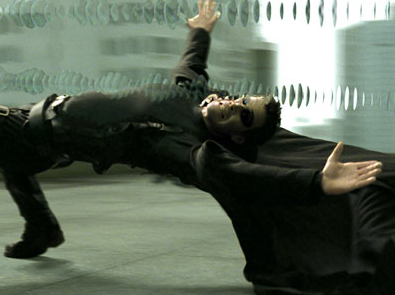
This phenomenon is also used to explain how animals have varying perceptions of time, and shows that animals that we would expect to be agile and fast moving are able to see time at a much quicker rate. This also explains why flies are so hard to catch, as they can see your hand moving towards them in slow motion, making it easy for them move out of its way with ease. This could also shed some light on how Neo managed to dodge all those bullets in The Matrix. 


On the flip side of this, there are also some species of tiger beetle who's body moves much faster than its eyes can process and has to stop every now and then to take in the new surroundings that its charged itself into. 

This information isn't only important for the information that we can gain from the complexities of the animals around us, but could have have some implications in human biology in the future. 

At the moment, the limit of a humans sensory perception is being pushed by people like Lewis Hamilton. When driving an F1 car, Lewis is moving at pretty much the limit of his biological abilities. If he were to move any faster his eyes wouldn't be able to take in his environment in enough time for him to react, which probably wouldn't result in a very pretty scenario. 

The only way for us to push ourselves past these limits would be either through drugs, which don't exist yet,  or the adaptation of our eyes at a cellular level. This might seem pretty unlikely but who knows, one day we could all be dodging bullets and trying to prevent the destruction of Zion. 


What do you think about this research? Comment below with your thoughts and questions and don't forget to +1 this article if you enjoyed it. 

If you're particularly interested in this research you can find the original research article here.

Sunday, 8 September 2013

Are you taking the piss?

7 years, 20 researchers and a whole lot of pee has allowed for a much more accurate chemical composition of urine to be determined. This has a number of knock on effects throughout scientific research, especially in the identification and treatment of medical disorders. 


Urine is a beautiful thing; available in every shade of yellow, sterile, chemically complex and one of the most ready available biofluids in the world. However, because of urine's vast complexity, it has been difficult to fully understand each of its components, and what those components can tell us about the person who supplied it. 


Urine usually contains metabolic breakdown products from the food that we eat and drink, contaminants we absorb from the environment as well as the by-products of certain bacteria.  The issue is the amount of information that we have about each of these components, which leaves us with a gap in our scientific knowledge on this substance. 

To try and remedy this gap in our knowledge, researchers at the University of Alberta set out to improve their knowledge by conducting an extensive and intense period of research which would provide a quantitative characterization of urine. Doing this involved employing NMR spectoscopy, gas chromotography, mess spectrometry and high performance liquid chromotography. 


Through the use of these technologies over 3000 previously unknown urine metabolites were identified. It is important for us to understand these metabolites, as they are often the products of a large number of different processes in the body, and can therefore give us an incredibly clear understanding of an organisms phenotype, from a source which is incredibly easy to obtain (pee). 

Now it might sound like that's an awful lot of effort to go through just to further understand our pee. However, this research will have massive implications on healthcare in the future. A persons urine can not only tell us a huge amount of information about someones health, but also their diet, what they drink, drugs they are taking and potential pollutants that they may have been exposed to. This can allow a physician to quickly identify a number of things about a patient through analysis of their urine, giving us the potential to save numerous lives through the identification of things like disease metabolites, allowing for quick treatment saving precious time.

What do you think about this research? Will it make you look at your pee in a different way from now on? Comment below with your thoughts. 

If you want to know any more about the experiments the team undertook then you can find the original research paper here.


Wednesday, 10 July 2013

Did Humans and Neanderthals speak to each other?

What’s the first thing that comes to mind when you hear the word Neanderthal? If you’re like most people you probably muster up an image of lumbering grunting brutes who are just less developed versions of ourselves. You wouldn't be blamed for thinking that either, it’s the image that has been engraved into our psyche since their discovery almost 200 years ago. However, in the last 10 years our perception of Neanderthals has changed considerably, and we now know them to much smarter than we ever gave them credit for.

The main reason for this change in our perception is the availability of ancient DNA, which is capable of giving us a much clearer and concise image of how the Neanderthals lived, and what they were capable of.
The latest piece of information to be gained in this way suggests that Neanderthals may have been capable of producing much more complex speech than we previously believed, whereas before we would have assumed that the most they were capable of were primitive grunts.

This has put a spanner in the works of most language experts who have always stuck to the theory that our ability to speak came about incredibly quickly, and due to very few mutations in our genome. If this were the case, it would mean that speech began development only around 50,000 years ago.  However, this new evidence means that the development of language must have happened over a much longer period of time, and originated more than a million years ago through a combination of genetic and cultural influences.

This could give us some big clues about the interaction between Neanderthals and our ancestors, who coexisted together for a long period of time. Could humans and Neanderthals have communicated with each other? Many assume that we out competed the Neanderthals, and that’s why they died out. However, there have been suggestions over the years that Neanderthals and humans interbred with each other, a theory supported by this new revelation.  

Can you imagine if Neanderthals were around today, with us being able to chat with them whenever we liked? Texting and emailing and calling whenever we pleased.


It would be a weird world, but one that I’d definitely enjoy living in.


What do you think about this story? Write below with your comments or questions and sign up for the mailing list at the top right of this page for notifications of whenever I leave a post. And don’t forget, if you enjoyed this post please +1 and reshare! 

Sunday, 7 July 2013

Spiders use electrostatic attraction to suck in their prey.

It has been shown that a spiders web is attracted to electrically charged objects, a fact which could help in the capture of its prey.

I’m not going to lie, I hate spiders. I feel like they’re always planning something, sneakily running around, making webs in corners and acting suspicious. And let’s be honest, who really needs that many legs?
Well it turns out my suspicions may have been founded, as new evidence has suggested that spiders are smarter than we give them credit for.

It has been shown that spider webs are attracted to objects that are electrically charged, causing the threads of the web to distort towards each other. This is important when you consider that some insects such as bees are capable of generating an electric charge when they flap their wings – causing the whole bee to be seen as electrically charged.  

That means that positively charged insects would only have to fly near a spider web, and they could be sucked in towards the web which deforms around them. This deformation dramatically increases the likelihood that they will be trapped and that the spider will get its next meal.

This is a really interesting piece of research, and could give us some insight into how we could adapt other materials to be of benefit to us. What isn’t known however is whether all insects are capable of producing a charge when flying, which could be the next stage in this investigation.

This is usually the point where I put up a picture of a spider. However, I’m going to skip that s
tep for this post, mainly because if I have to upload a picture that means I’ll have to look at a spider, something I try pretty hard to avoid, especially after knowing how sneaky they are.


What do you think about this discovery? Write below with your comments or questions and sign up to the mailing list on the right of this page to get notifications of whenever I leave a post. 

Saturday, 6 July 2013

Moths send sonic blasts from their genitals.

Hawkmoths have been shown capable of producing ultrasound as a defence against bats. This on its own isn’t unique, what is unique is the source of that ultrasound – their genitals.

Have you ever casually glanced down at your genitals and wished that they had more functions? Well if you have this story might make you pretty envious. That’s because recent evidence has suggested that Hawkmoths (found mainly in the tropics) are capable of using their genitals to produce a loud beam of ultrasound.

Whilst I wish there wasn’t any purpose to this, there unfortunately is.


For millions of years, bats and moths have been competing against each other in an epic battle against one another. Each have been adapting and evolving in an attempt to outdo the other, and this genital sonic blast seems to be just the latest in a long list of adaptations.

Whilst the purpose of this behaviour hasn’t been fully confirmed, it was observed that the moths produced this ultrasonic sound whenever bats approached. It can therefore be assumed that the hawkmoth’s ultrasound either gives a warning to the bats to stay away, or is capable of jamming the sonar that the bats use to visualise their environment, thus preventing the bats from ‘seeing’ them.

This is a great little discovery, and just goes to show how far evolution can push a species, and the methods that they use to defend themselves.

If you’ve like to know more about how prey and predator both evolve alongside each other, then read about the Red Queen Hypothesis here.

Also, just in case any of you have ever played Pokemon, yes, one of venomoths moves was supersonic. Maybe we should look to Pokemon for more future discoveries about animals?


What do you think about this discovery? Write below with your comments or questions and sign up for the mailing list at the top right of this page for notifications of whenever I leave a post. 

Friday, 5 July 2013

New method of bacterial communication discovered.

Antibiotic resistance is one of the major health risks of the modern age, and could set our health care system back by decades. Much research has been geared towards preventing this problem, including the use of silver which I described in a recent post which you can find here

New research may have given us the foothold that we need in the fight against antibiotic resistant bacteria. This research suggests that resistant bacteria within a population are capable of communicating with bacteria that are less resistant, through chemical communication using small amino acid molecules. This can then be used in turn, to make those bacteria resistant, spreading that resistance throughout the population. 

These small molecules can also be produced by almost all forms of bacteria, which suggests that they are a form of universal communication. Therefore, if we were able to block these small amino acids, we may be able to prevent the rapid spread of resistance between groups of bacteria. 

What do you think about this research? Write below with your comments or questions. 

Building a heart from scratch: A how to guide.

A few weeks ago I wrote a post called ‘How can you mend a broken heart?’ which you can find here, and now i find myself being able to talk about the extraordinary feat of actually building one from scratch.

There has always been a shortage in the amount of heart transplants available for those patients who need them, mainly due to damage through illness or resuscitation attempts. Whilst some efforts to resolve this problem have involved trying to get more people to donate their hearts after they die, one lab in America is attempting to circumvent this problem completely, by growing them from scratch instead.

It’s an easy enough thing to say, but in practice the growth of whole human organs has proven incredible difficult. Some success has been achieved with the growth of the most simple, hollow organs like the trachea and the bladder, but the amount of coordination required between dozens of different cell types within a complex organ makes it near impossible.


Because of this, researchers quickly realised that they would need an already functioning biological scaffold to build their heart around. That scaffold came in the form of a different recently deceased heart which had been stripped of its cells (decellularization). This left behind only the supporting extracellular matrix and collagen which could then be repopulated by new cells (recellularization). Now, that might not seem to make much sense. Why would you take an already functioning heart and strip it of all its cells, only to then later replace those cells? To answer that we need to think about the main problem facing tissue transplants, which is tissue rejection.

If any of you have ever watched ER or House, and a patient in need of an organ transplant is being treated, you’ll probably have heard the phrase ‘is there a tissue match?’ That means that for an organ to be transplanted into a patient, that organ needs to be similar enough to the patient so that their immune system doesn’t reject it. This results in a lot of people who need an organ being left without, due to the fact that any available organs aren’t a ‘tissue match’.

With this new method of organ growth, tissue rejection isn’t a possibility. This is because of the source of cells that are used to regrow the heart tissue – the patient needing the transplant.  By using adult cells from the patient, and reprogramming them into thinking that they’re stem cells (turning them into induced pluripotent stem cells or iPS cells), the cells of the new heart will be an identical genetic match to the patient, ensuring that the new organ won’t be rejected.

If that were the end of the story then we would have solved the problem of organ shortage and a lot of people would be much better off. However, in science things don’t always go to plan. It might be easy to say ‘let’s use stem cells to regrow the heart’, but in reality the number of factors that contribute to the growth of an organ are exponential, all of which need to be recreated to grow an organ in the lab. Cells are able to sense the environment around them, including the pressure being forced upon them from other cells, the beating action of a functioning heart, as well as the nutrients and oxygen around them. To try and recreate these conditions, researchers placed the heart in a bioreactor that attempts to mimic the hearts natural environment. This provided some positive results, with organs being transplanted into rats and fully functioning, even if only for a short period of time.


This marks a monumental step forward in our ability to grow organs that are specifically tailored to the needs of a patient. However, there are some sceptics.  Many believe that there are too many complications in the field of tissue regeneration for this to ever be a viable source of organs, and that the most we can ever hope to achieve is the generation of parts of an organ, such as lobes of a kidney or valves of a heart. Well, let’s just hope that they’re wrong. 

What do you think about this research? Write below with your comments or questions, and join the mailing list at the top right of this page to get emails every time I leave a post.